The Final Chapter for Sony’s Universe: The film marked the final installment and “final nail in the coffin” for Sony’s separate Spider-Man spin-off universe (which included Morbius and Madame Web).
Critical and Box Office Reception: Upon release, the movie drew harsh reviews (scoring very low on Rotten Tomatoes) and struggled at the box office, sparking widespread internet memes, critical breakdowns, and retrospective discussions online.
Tone and Changes to the Character: Fans and critics heavily discussed the movie’s unusual choice to turn the big-game comic villain into an anti-hero and self-described “animal protector,” contrasting sharply with classic source material like Kraven’s Last Hunt.
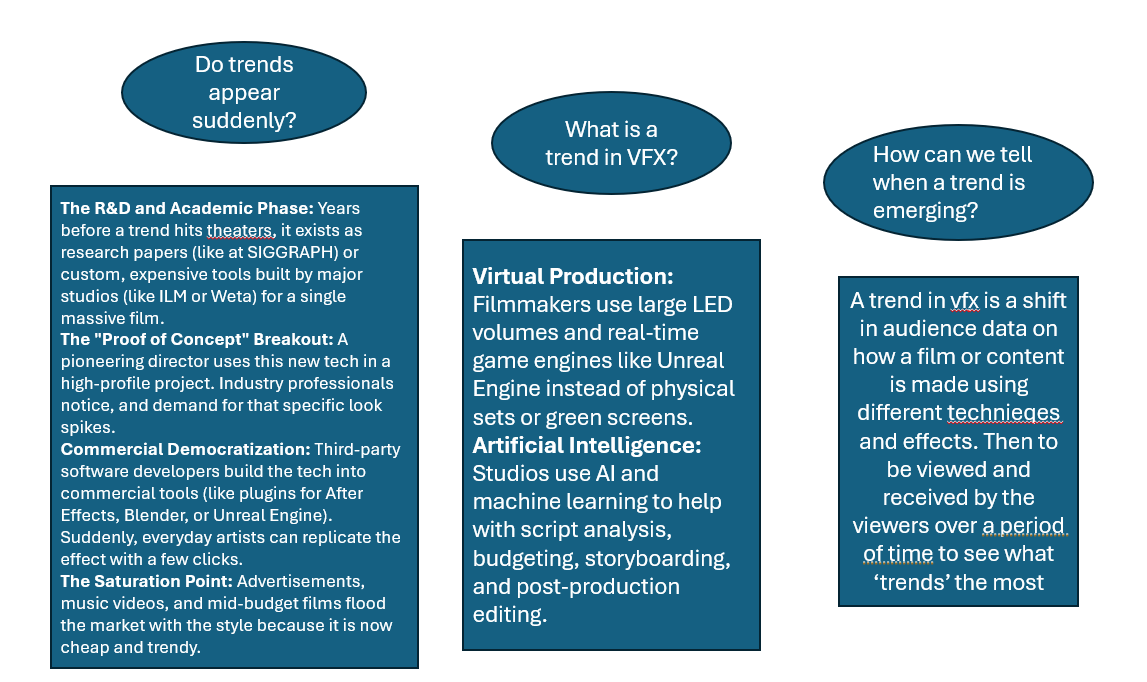
example of current vfx trending technique’s
BREAKDOWN…
Visual effects studios like Image Engine and Rodeo FX handled the major CGI and digital breakdown sequences for Kraven the Hunter (2024), focusing on creature transformations, digital doubles, and environment enhancements.
Key VFX Scenes and Sequences
The Rhino Transformation: Aleksei Sytsevich’s biological mutation features complex muscle volume changes, scaly stone-like plate formations, skin color transitions, and digital double replacements.
Environment Extensions: CG mountain lairs, wide valley expanses, African plains, and full-CG ravines were built to expand the live-action forest and hunting settings.
Action and Combat Sets: Heavy compositing work brought explosive helicopter attacks with phosphorus missile launches, debris simulations, gunfire, and building collapses to life.
Facial and Character Effects: Studios utilized digital double face-morphing for unmasking Dmitri/Chameleon, alongside notable digital fixes for dialogue and character shots
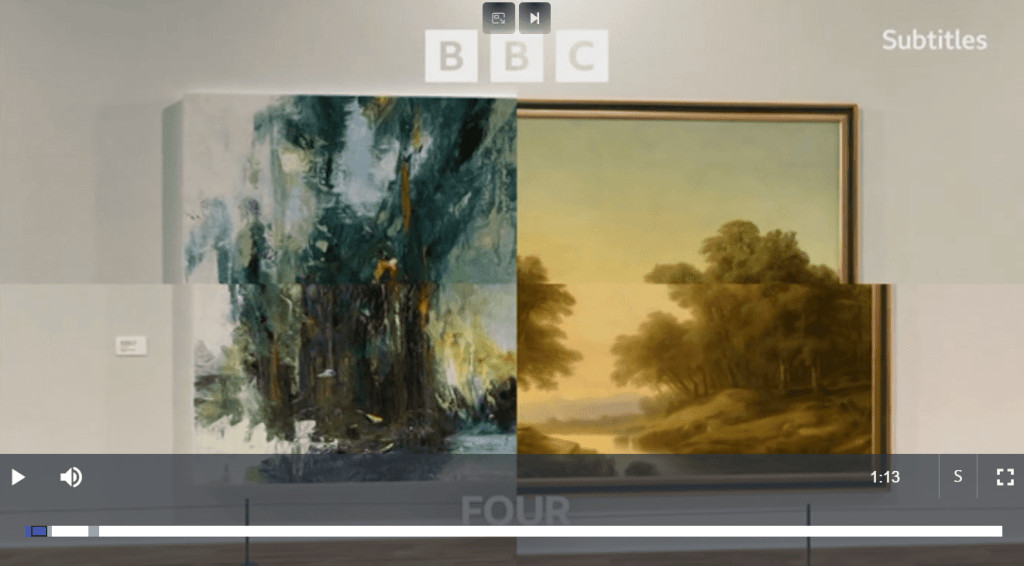
Investigate: To prepare for class, James Fox’s documentary The Age of the Image (2020). Harvard Reference:
A New Reality’ (2020) Age of the Image, Series 1, episode 1. BBC 4, Television, 24 February 2021.
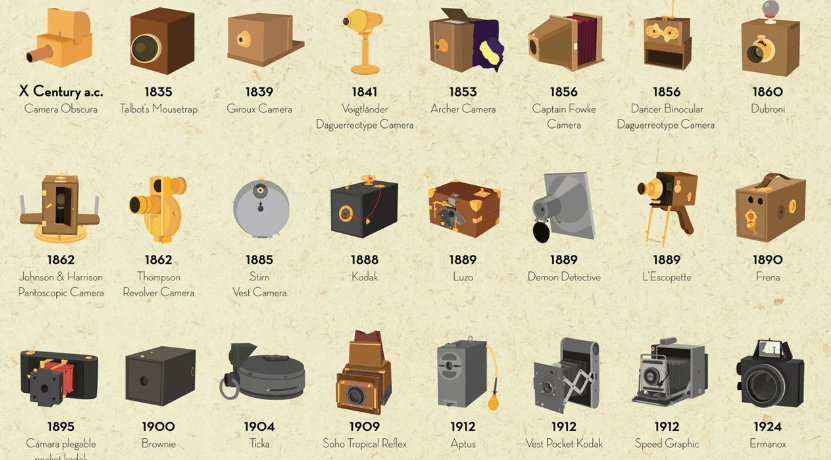
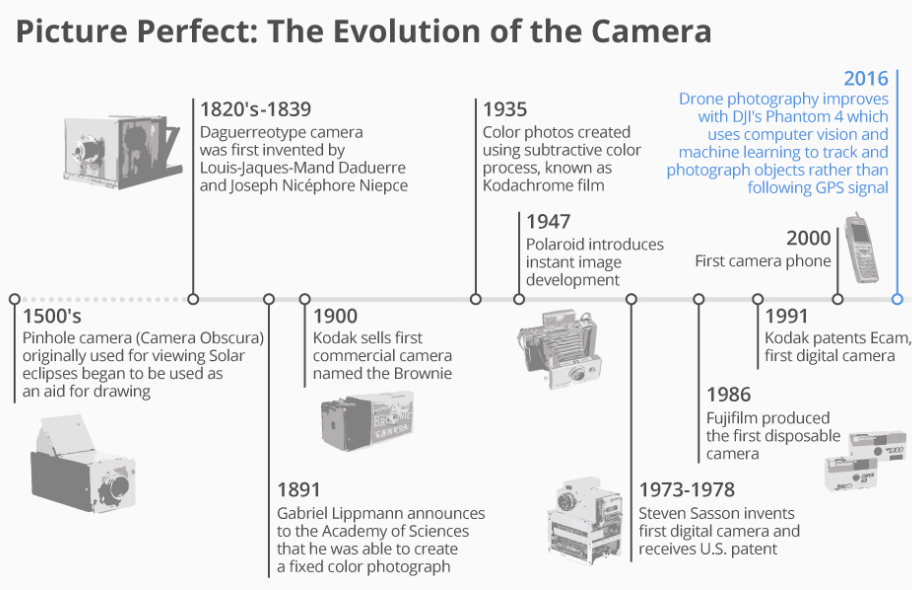
The Optical Dawn: From the Camera Obscura to Permanence
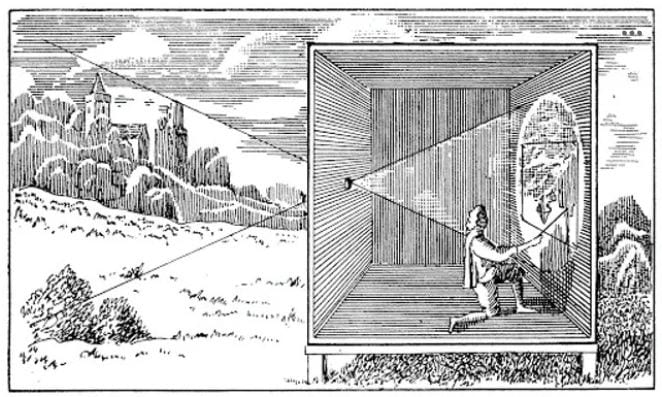
The story begins long before the click of a shutter, rooted in the concept of the camera obscura Latin for “dark chamber”. Documented as early as ancient Greece and China, and later refined by scholars like Ibn al-Haytham, this device projected an outside scene through a small hole onto an opposite wall. For centuries, artists used it as a tracing aid, unable to make the fleeting picture stay. That changed in the 1820s when Joseph Nicéphore Niépce used heliography to capture the first permanent photograph, followed shortly by Louis Daguerre’s expensive metal-plate daguerreotype in 1839 and William Henry Fox Talbot’s replicable calotype process.
The Industrial Age: Mass Photography and Film
Photography broke free of the laboratory when chemistry met industrial design. In 1884 and 1888, George Eastman patented flexible roll film and launched the portable Kodak camera with the famous pitch: “You press the button, we do the rest”. Suddenly, everyday people could document their lives. In the early 20th century, the shift to 35mm film—championed by Leica—shrank the machinery. Cameras became nimble companions for street photographers and photojournalists. Mid-century innovations like single-lens reflex (SLR) cameras and instant Polaroid film gave creators immediate tactile feedback and physical control over depth and light.
The Digital Shift: Pixels and Portability
By the late 20th century, film began its retreat as electronic sensors took over. Steven Sasson built Kodak’s first digital prototype in 1975, and by the 1990s, digital cameras and DSLRs allowed photographers to skip the darkroom entirely. Images transformed into data files—JPEGs and MP4s—that could be viewed, deleted, and multiplied without the recurring cost of physical film rolls. Mirrorless systems later discarded the heavy mechanical reflex mirror altogether, making professional-grade optics faster, quieter, and lighter.
The Modern Era: Computational Photography
Today, the physical camera has largely dissolved into the smartphone. Modern mobile photography relies less on traditional glass lens capture and more on computational photography where microprocessors and artificial intelligence stitch together multiple frames, adjust lighting in real-time, and digitally synthesize reality. The camera is no longer just a passive box that catches light; it is an active, omnipresent layer of digital perception.
example of evolution in imagery
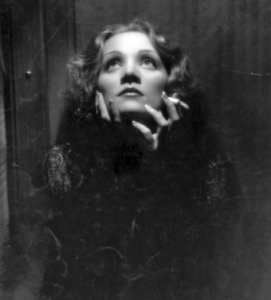
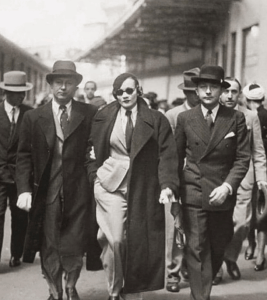
The iconic image of Marlene Dietrich standing in a tailored, wide-legged trouser suit remains one of the most revolutionary visual moments in fashion history. In an era where women were legally, socially, and culturally expected to wear skirts and dresses, Dietrich boldly claimed menswear as her own. By adopting trousers both on and off the screen, she did not merely introduce a new trend; she challenged the traditional boundaries of gender, redefined modern femininity, and transformed the suit into a permanent symbol of female empowerment.
Dietrich’s relationship with trousers began long before it became a Hollywood sensation. In the vibrant, progressive atmosphere of Weimar Berlin during the 1920s, gender experimentation in fashion and art was already blossoming. Dietrich immersed herself in this avant-garde subculture, frequently wearing tailored men’s clothing to cabaret shows and social events. When she moved to Hollywood under the mentorship of director Josef von Sternberg, she brought this rebellious sensibility with her. The defining moment of this transition occurred in her American film debut, Morocco (1930). In a famous cabaret scene, Dietrich performs wearing a full men’s tuxedo and top hat, famously kissing a female audience member. The scene shocked audiences but instantly cemented her status as a daring, sophisticated icon.
What made Dietrich’s use of trousers truly revolutionary was her insistence on wearing them in her everyday life. To Dietrich, trousers were not just a theatrical costume or a publicity stunt; they were a practical, comfortable, and elegant choice for a modern woman. She worked closely with top tailors, ensuring her trousers were immaculately cut to fit her frame while retaining masculine proportions, complete with sharp pleats and deep pockets. Her off-screen preference for trousers frequently caused public outrage. In 1933, the Chief of Paris Police famously threatened to arrest Dietrich for violating a local ordinance that banned women from wearing pants in public. Undeterred, she stepped off her train in Paris wearing a sleek tweed trouser suit, beret, and sunglasses, effectively weaponizing glamour against bureaucratic control.
Dietrich’s choice to wear trousers carried profound political and social weight. In the early 20th century, clothing was a rigid enforcer of gender roles. Men’s clothing symbolized authority, freedom of movement, and public power, while women’s clothing often restricted physical mobility and signaled domesticity. By adopting the suit, Dietrich claimed the autonomy and power associated with manhood without sacrificing her sensuality. She proved that a woman could be intensely attractive and deeply feminine while dressed in clothing designed for men. In doing so, she dismantled the rigid dichotomy of the era and expanded the visual vocabulary of what a woman could be.
The legacy of Marlene Dietrich’s trousers is visible on every modern fashion runway and in everyday wardrobe choices. She paved the way for subsequent generations of designers—most notably Yves Saint Laurent, who introduced “Le Smoking” tuxedo for women in 1966—and future style icons like Katherine Hepburn and Diane Keaton. Today, the power suit is a staple of women’s professional and high-fashion wardrobes, a direct evolution of the trail Dietrich blazed nearly a century ago. Marlene Dietrich did not just wear trousers; she used them to redraw the lines of identity, making her one of the most enduring architects of modern style and female liberation.
camera obscure is a natural optical phenomenon that laid the foundation for modern photography. For centuries, artists, scholars, and scientists used this exact method to drill a small hole in a wall or tent projecting an outside scene onto a dark surface as a tool for viewing eclipses and tracing highly accurate drawings.
While they couldn’t freeze the light automatically, the breakthrough to permanently capture these projected images on paper finally came in 1826 when French inventor Nicéphore Niépce created the world’s first permanent photograph, View from the Window at Le Gras. He succeeded by coating a pewter plate with a light-sensitive petroleum derivative called bitumen of Judea, which hardened where the light hit it, leaving behind a permanent image after an exposure that lasted several hours.
Would you like to know more about how Nicép
, unfortunately they did not have the means of capturing the picture onto paper, this didn’t happen till till the pin hole camera has been around for hundreds of years.
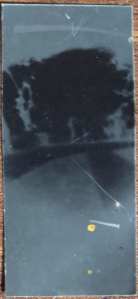
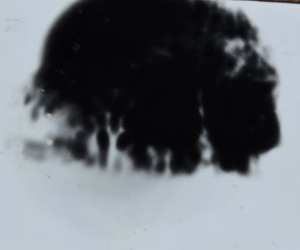
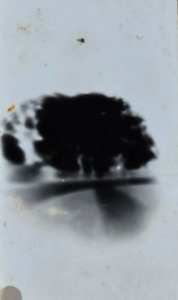
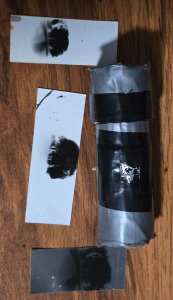
my own hand made pin hole camera, the first tyre of camera that could successfully capture imaginary onto paper, the photos i have captured are at Farnham university in the garden grounds, what you see is oak trees and paths, the bushy tops of the trees stay black and the trucks white or light gray.
Harold Edgerton Digital Collections inspiration comparison to modern film
The Art of the Unseen: High-Speed Spectacle in Ghost in the Shell and Harold Edgerton’s Photography
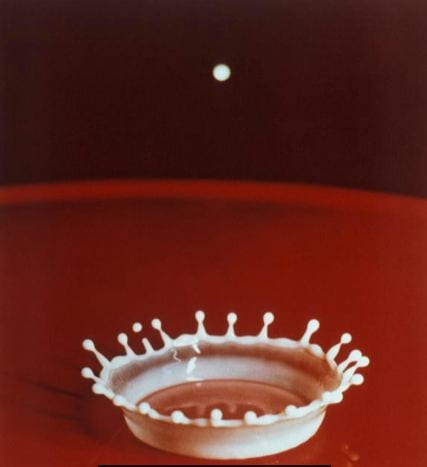
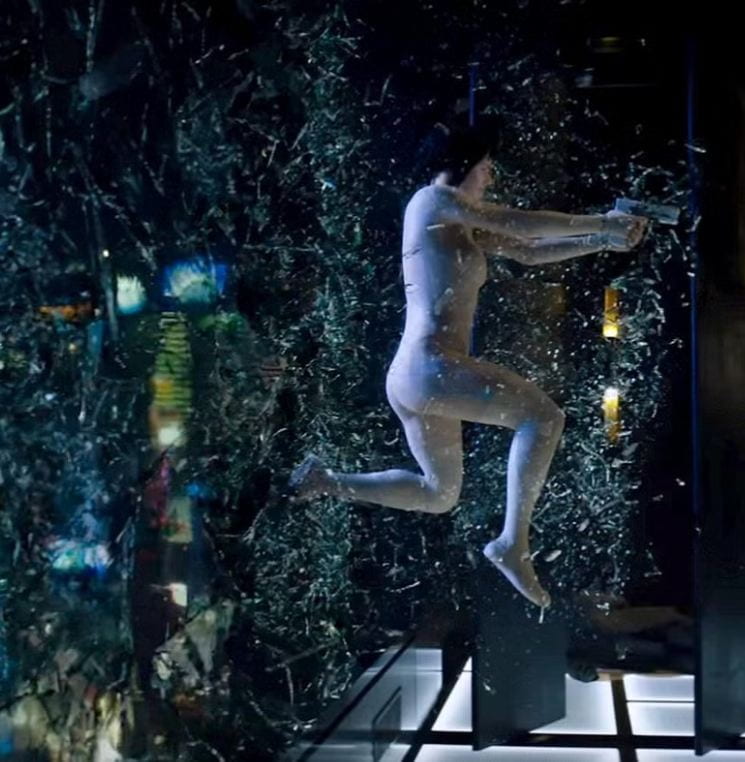
In modern cinema, action sequences frequently rely on temporal manipulation to elevate the mundane into the extraordinary. A prime example of this technique occurs in the 2017 live-action film Ghost in the Shell, during the iconic sequence where Scarlett Johansson’s character bursts through a glass window. As she breaches the barrier, the film abruptly cuts to super slow-motion. This allows the audience to witness the glass shattering into a suspension of countless minute shards that erupt outward into the air in every direction. This cinematic choice directly mirrors the pioneering high-speed photography of Harold Edgerton, specifically his seminal 1957 work, Milk Drop Coronet.
The structural and aesthetic parallels between these two visual mediums are striking. Because the human eye cannot perceive events that occur in a fraction of a second, both Edgerton’s stroboscopic photography and the film’s high-speed cinematography reveal a hidden reality, offering viewers an experience entirely outside of normal human perception.
Furthermore, the physical composition of the shattering glass in Ghost in the Shell functions as a direct visual echo of Edgerton’s milk drop. When Johansson passes through the window, the outward radial spread of the glass shards mimics the iconic “coronet” or crown formation captured in Edgerton’s fluid dynamics photography. Though presented from a different perspective and polished with modern cinematic styling, the dispersing glass behaves exactly like the splashing milk, freezing a chaotic, fleeting impact into a moment of sublime, structured artistry.
BULLET AND BLAST
JUDGE DREDD
Cinematic Time vs. Scientific Precision: The Anatomy of Ultra-Slow Motion
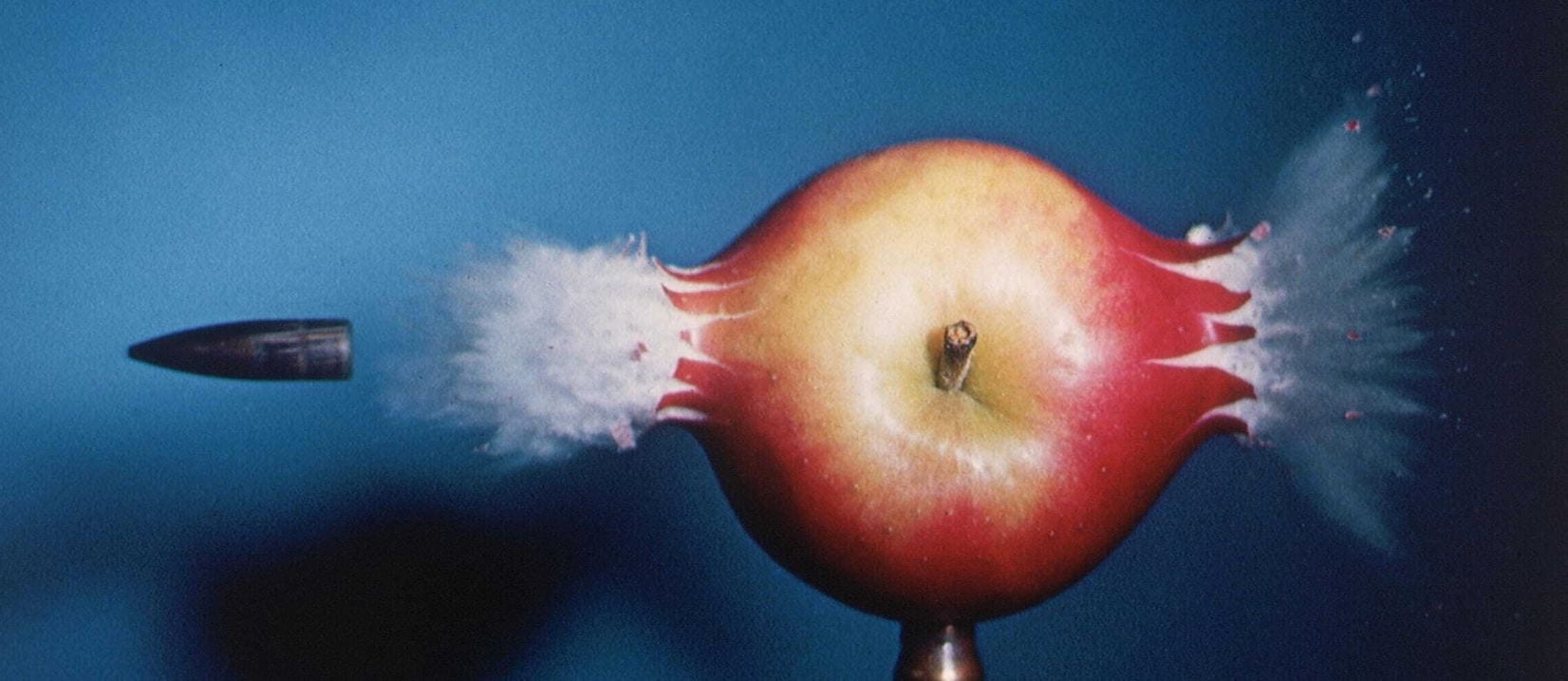
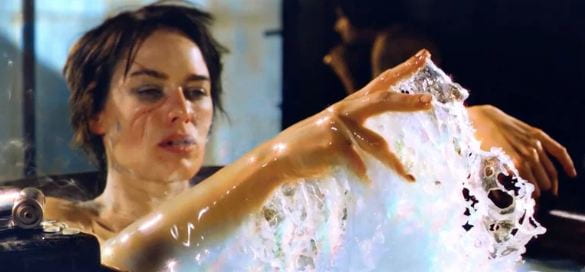
My second comparison pairs the “Slo-Mo” drug sequence from Dredd (2012) with the iconic high-speed photography of a bullet piercing an apple. This comparison highlights how ultra-high-speed cinematography can capture a “strain in time.” When extreme slow motion is applied to a hyper-focused event, static environments transform. The surroundings appear to bend and ripple around the central action—a physics-defying phenomenon that remains completely invisible to the naked eye and can only be unveiled through a camera lens.
In Dredd, the crime lord Ma Ma consumes a futuristic drug called “Slo-Mo,” which alters the user’s perception by slowing down their visual reality to a fraction of its normal speed. The director utilizes this narrative device to create a striking visual effect, allowing the audience to intimately experience the character’s heightened, altered state of mind. Without this extreme frame-rate manipulation, the human eye would miss the poetic physics of the scene—such as the delicate, sculptural wave of water that clings to Ma Ma’s hand and rises into the air, making the fluid look like an extension of her own body.
In contrast, the classic imagery of a bullet shattering an apple captures a similar rupture in time, but through a lens of scientific precision rather than sensory euphoria. While Dredd uses slow motion to externalize an internal, emotional state, the bullet-and-apple photograph isolates a micro-second of violent impact. Both examples, however, rely on the exact same cinematic principle: they stretch a microscopic fragment of time into a macro-experience, forcing the viewer to appreciate the hidden, fluid mechanics of a world moving too fast for human biology to comprehend.
THE AGE OF IMAGE
my explanation to the age of imagery and how it has evolved humans, everything is about time and imagery has helped keep a moment alive and stuck in time forever
Introduction: The Radical Edge of Print
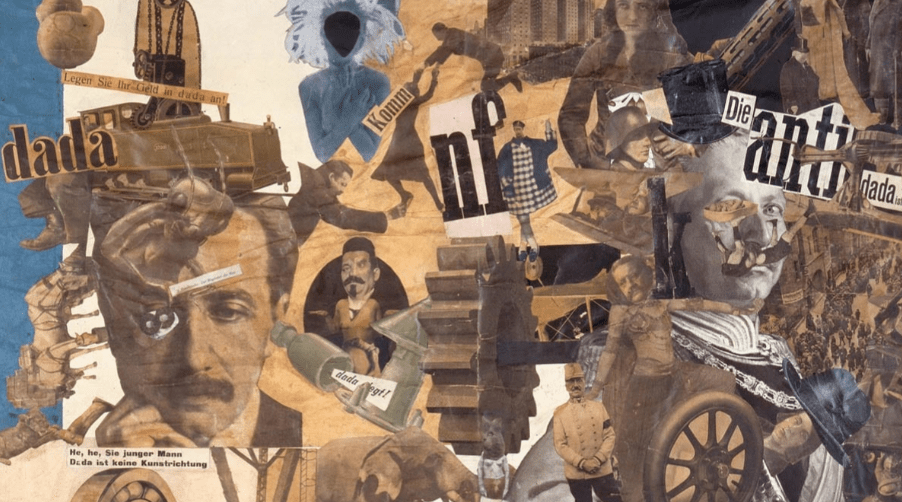
In the chaotic aftermath of World War I, German society splintered under political failure, economic ruin, and shifting social norms. Out of this turbulence rose the Dada movement, a group of artists bent on shocking, confusing, and dismantling traditional high art. Among them stood Hannah Höch, a visionary creator who helped invent and popularize the art of photomontage. Working with scissors, glue, and printed matter pulled straight from contemporary newspapers and illustrated magazines, Höch forged a new visual language. Her collages turned the noise of modern media back onto itself, exposing the contradictions of the Weimar Republic.
Pioneering Photomontage and Berlin Dada
Höch played a foundational role in the Berlin Dada circle, collaborating and sharing ideas with figures like Raoul Hausmann. Yet, as the sole woman in the core group, she frequently encountered the condescension of her male peers, who struggled to view her as an equal collaborator rather than a muse or assistant. Despite this friction, Höch stood her ground. She believed that Dada’s radical rebellion had to address real social structures.
Her defining masterpiece from this era, Cut with the Kitchen Knife Dada through the Last Weimar Beer-Belly Cultural Epoch of Germany (1919–1920), became a cornerstone of the movement. The sprawling, chaotic composition acts as a visual cross-section of post-war Germany, jumbling politicians, military leaders, factory machinery, and Dada cohorts into a biting critique of patriarchy and state power.
Deconstructing Gender and the “New Woman”
A central thread in Höch’s art is her interrogation of gender. During the Weimar era, society celebrated the myth of the “New Woman”—an independent, wage-earning, modern figure—while still chaining women to traditional domestic expectations. Höch exposed this hypocrisy. Through her work, she spliced female faces with mechanical parts, baby bodies, and male suits, revealing how modern culture manufactured a contradictory ideal for women. She also explored broader identities, touching upon androgyny and alternative relationships, including her personal and artistic ties with writer Til Brugman.
Later Series and Resilience Under Nazism
Höch’s critical eye extended beyond gender to race and global politics. In her From an Ethnographic Museum series (1924–1930), she juxtaposed European fashion models with non-Western artifacts and masks, challenging how Western media exoticized or stereotyped foreign bodies.
When the National Socialist regime seized power in 1933, they condemned Dadaism as “degenerate” art. While many of her male colleagues fled Germany, Höch chose internal exile. She retreated to a quiet, wooded area on the outskirts of Berlin, living incognito and working in secret through the horrors of World War II. Legacy
Höch survived the war and continued to create art for decades, eventually blending her sharp photo-based compositions with abstract and colorful forms. Though long sidelined by art history books that favored her male contemporaries, modern retrospectives—such as those hosted by the MoMA and the Whitechapel Gallery—have cemented her place as a titanic force of 20th-century art. She proved that a pair of scissors and a stack of old magazines could cut deeper than any paintbrush
Week 2: Photographic Truth Claim
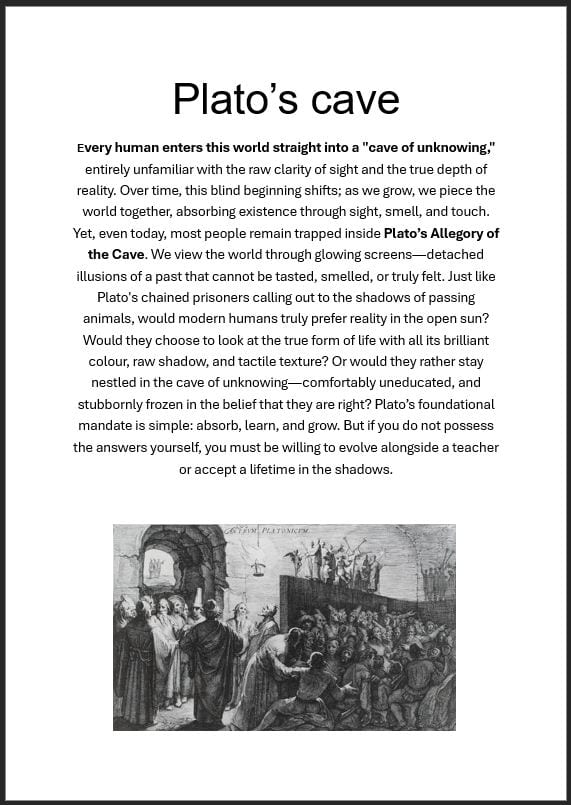
Introduction to the cave
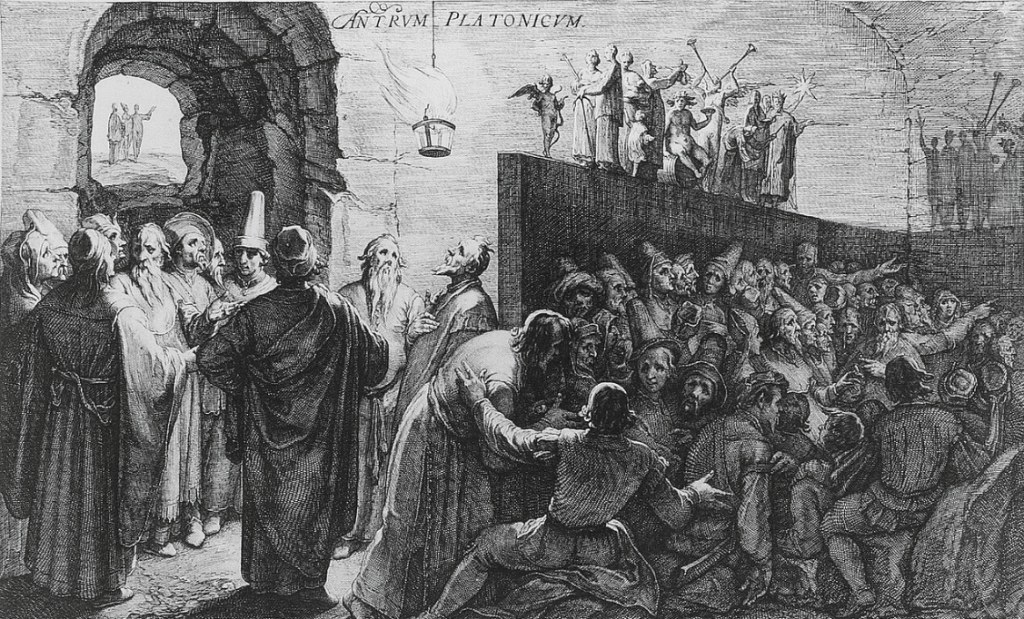
Plato begins by having Socrates ask Glaucon to imagine a cave where people have been imprisoned from childhood. These prisoners are chained so that their legs and necks are fixed, forcing them to gaze at the wall in front of them and not to look around at the cave, each other, or themselves. Behind the prisoners is a fire, and between the fire and the prisoners is a raised walkway with a low wall, behind which people walk carrying objects or puppets “of men and other living things”.
The people walk behind the wall so their bodies do not cast shadows for the prisoners to see, but the objects they carry do (“just as puppet showmen have screens in front of them at which they work their puppets”) The prisoners cannot see any of what is happening behind them; they are only able to see the shadows cast upon the cave wall in front of them. The sounds of the people talking echo off the walls; the prisoners believe these sounds come from the shadows.]
Socrates suggests that the shadows are reality for the prisoners because they have never seen anything else; they do not realize that what they see are shadows of objects in front of a fire, much less that these objects are inspired by real things outside the cave which they do not see.
Departure from the cave
Socrates then supposes that the prisoners are forcefully released. A freed prisoner would look around and see the fire. The light would hurt his eyes and make it difficult for him to see the objects casting the shadows. If he were told that what he is seeing is real instead of the other version of reality he sees on the wall, he would not believe it. In his pain, Socrates continues, the freed prisoner would turn away and run back to what he is accustomed to (that is, the shadows of the carried objects). The light “… would hurt his eyes, and he would escape by turning away to the things which he was able to look at, and these he would believe to be clearer than what was being shown to him”.
Socrates continues: “Suppose… that someone should drag him… by force, up the rough ascent, the steep way up, and never stop until he could drag him out into the light of the sun”. The prisoner would be angry and in pain, and this would only worsen when the radiant light of the sun overwhelms his eyes and blinds him.
“Slowly, his eyes adjust to the light of the sun. First he can see only shadows. Gradually he can see the reflections of people and things in water and then later see the people and things themselves. Eventually, he is able to look at the stars and moon at night until finally he can look upon the sun itself, Only after he can look straight at the sun “is he able to reason about it” and what it is.
Return to the cave
Socrates continues, saying that the free prisoner would think that the world outside the cave was superior to the world he experienced in the cave and attempt to share this with the prisoners remaining in the cave attempting to bring them onto the journey he had just endured; “he would bless himself for the change, and pity [the other prisoners]” and would want to bring his fellow cave dwellers out of the cave and into the sunlight.
The returning prisoner, whose eyes have become accustomed to the sunlight, would be blind when he re-entered the cave, just as he was when he was first exposed to the sun. The prisoners who remained, according to the dialogue, would infer from the returning man’s blindness that the journey out of the cave had harmed him and that they should not undertake a similar journey. Socrates concludes that the prisoners, if they were able, would therefore reach out and kill anyone who attempted to drag them out of the cave
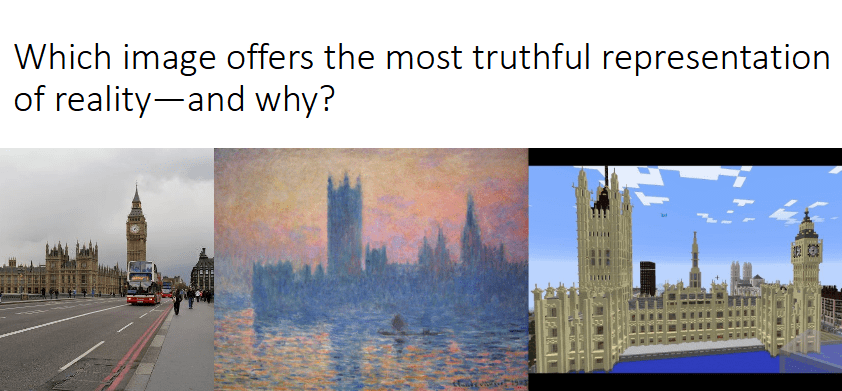
Buckingham Palace stands as a monumental figure of political power, operating like Plato’s Cave for those who have never seen it in person. To the uninitiated, who know the palace only through distant rumors, it exists as a mythic, medieval monolith—looking down on London, forever watching its people.
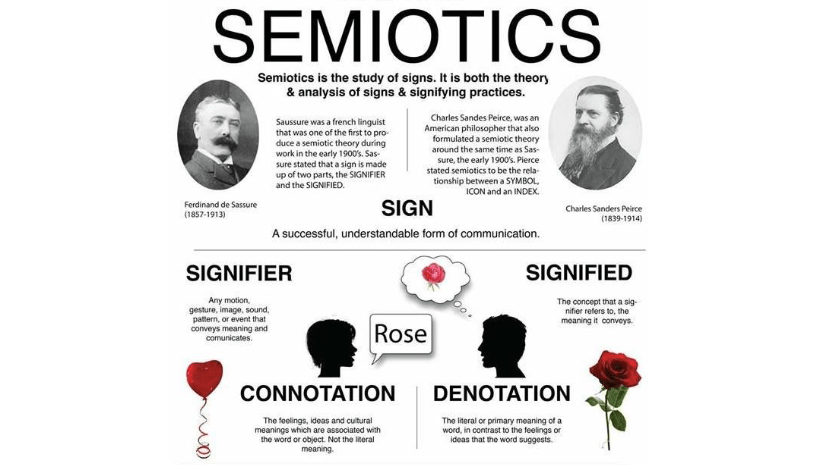
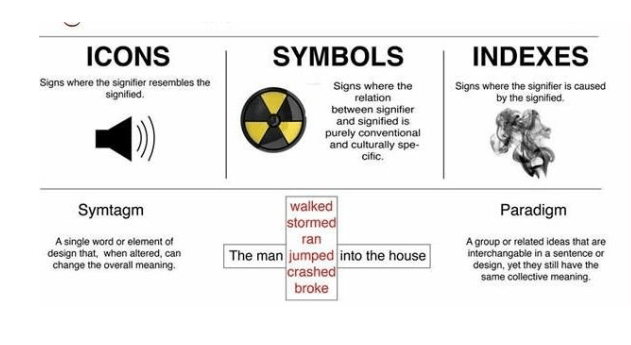
The three visual mediums break down this power through different semiotic lenses:
The Painting (Indexical): This is not a lifelike reproduction filled with intricate detail, but a direct, raw imprint of an idea. It captures a dark, dirty giant. It strips away the royal glamour to reveal the murky waters of London and a sky choked with light pollution, casting the palace in a heavy black shadow that signifies an internal, systemic darkness.
The 3D Design (Iconic): This medium functions iconically because it directly resembles the physical form and architectural grandeur of the actual palace, providing a tangible, structural imitation.
The Photograph (Symbolic): The photograph bridges the gap, serving as the symbol that binds the icon (the physical resemblance) to the signified (the deeper cultural, political, and historical meanings of royal power).
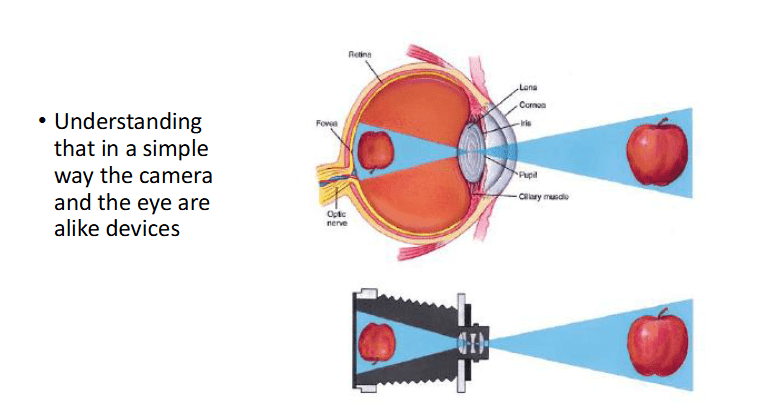
The human eye and a digital single-lens reflex (DSLR) camera share a remarkably similar baseline design—both use convex lenses, control light through an aperture, and project an inverted image onto a light-sensitive surface. However, while a DSLR captures a static, objective slice of time on a silicon sensor, the human eye operates as a biological-neurological partnership that continuously builds and edits reality.
Structural Parallels
At a mechanical level, the analogy between the two is striking.
The Aperture: The dark, central opening of the eye—the pupil—expands and contracts via the iris to regulate incoming light, functioning identically to the physical aperture blades inside a camera lens. [1]
The Lens: The cornea and internal crystalline lens of the eye bend and refract incoming light, just like the glass elements inside a DSLR zoom or prime lens. [1, 2]
The Sensor: The retina acts as the biological equivalent of a digital image sensor or piece of film, lined with millions of light-detecting cells (rods for low light and cones for color).
Fundamental Differences
Despite these shared blueprints, how they process and record the world splits them into two entirely different categories of technology.
Focus and Accommodation: A DSLR physically moves internal glass elements back and forth or shifts the focus ring to change focal planes. The human eye uses tiny ciliary muscles to actively warp and change the physical shape of its flexible lens in a fraction of a second.
Resolution and Field of View: A DSLR sensor has a uniform grid of pixels across the entire frame. The human eye is non-linear: a single sharp glance resolves roughly 5 to 15 megapixels (peaking around 52 megapixels only in the tiny central fovea), while peripheral vision drops off sharply. However, our eyes dart around rapidly (saccades) and stitch together a wide, sweeping mental panorama.
Dynamic Range and Light: A DSLR has a fixed dynamic range per exposure (often around 8 to 14 stops), meaning bright skies blow out to white or shadows crush into pure black unless you shoot in RAW and edit later. The human eye-brain system dynamically adjusts rhodopsin levels and continuously re-exposes scenes on the fly, yielding an adaptive range that easily surpasses 24 stops.
The Role of the Brain: A camera records raw physical data onto a memory card. The eye simply acts as a video feed provider; the heavy lifting is done by the brain, which automatically corrects color temperatures, fills in a blind spot with “content-aware fill”, merges two separate angles into 3D space, and stabilizes motion
Week 3: Faking Photographs: Image manipulation, computer collage and the impression of reality
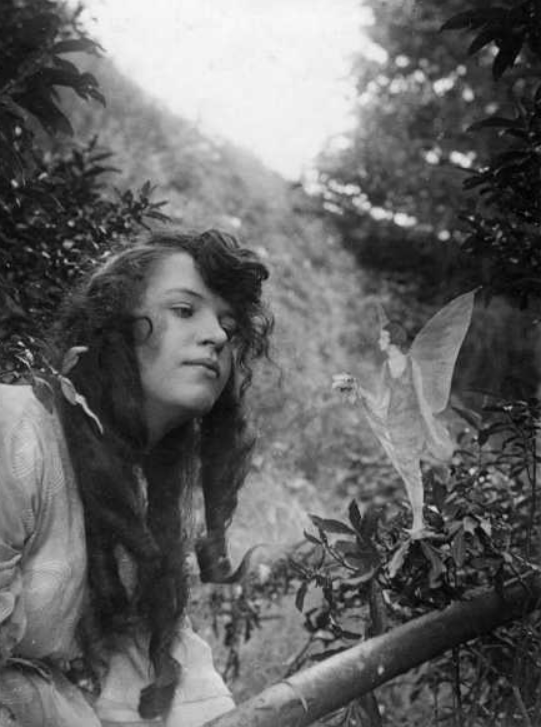
Cottingley Fairies – Fairy Offering Posy of Harebells to Elsie
Though the five famous photographs of a young girl surrounded by fairies were actually shot in 1917, they remained one of the world’s most successful photographic hoaxes for over 60 years. It wasn’t until 1983 that the two cousins involved, Elsie Wright and Frances Griffiths, finally admitted in a magazine interview that the photographs were entirely faked. They explained how they had used cardboard cutouts of dancing girls copied from a popular children’s book, added wings, and pinned them to the bushes with hatpins
Doyle’s article in the December 1920 issue of The Strand contained two higher-resolution prints of the 1917 photographs, and sold out within days of publication. To protect the girls’ anonymity, Frances and Elsie were called Alice and Iris respectively, and the Wright family was referred to as the “Carpenters”. An enthusiastic and committed spiritualist, Doyle hoped that if the photographs convinced the public of the existence of fairies then they might more readily accept other psychic phenomena. He ended his article with the words:
‘The recognition of their existence will jolt the material twentieth-century mind out of its heavy ruts in the mud, and will make it admit that there is a glamour and mystery to life. Having discovered this, the world will not find it so difficult to accept that spiritual message supported by physical facts which have already been put before it’
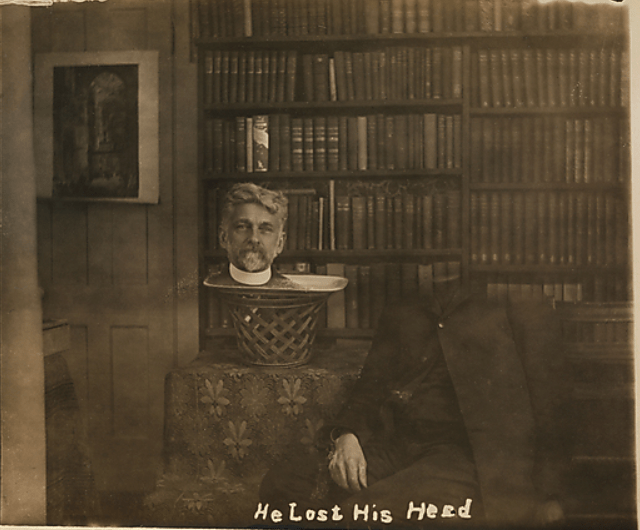
Unknown photographer (American) He Lost His Head
Nd
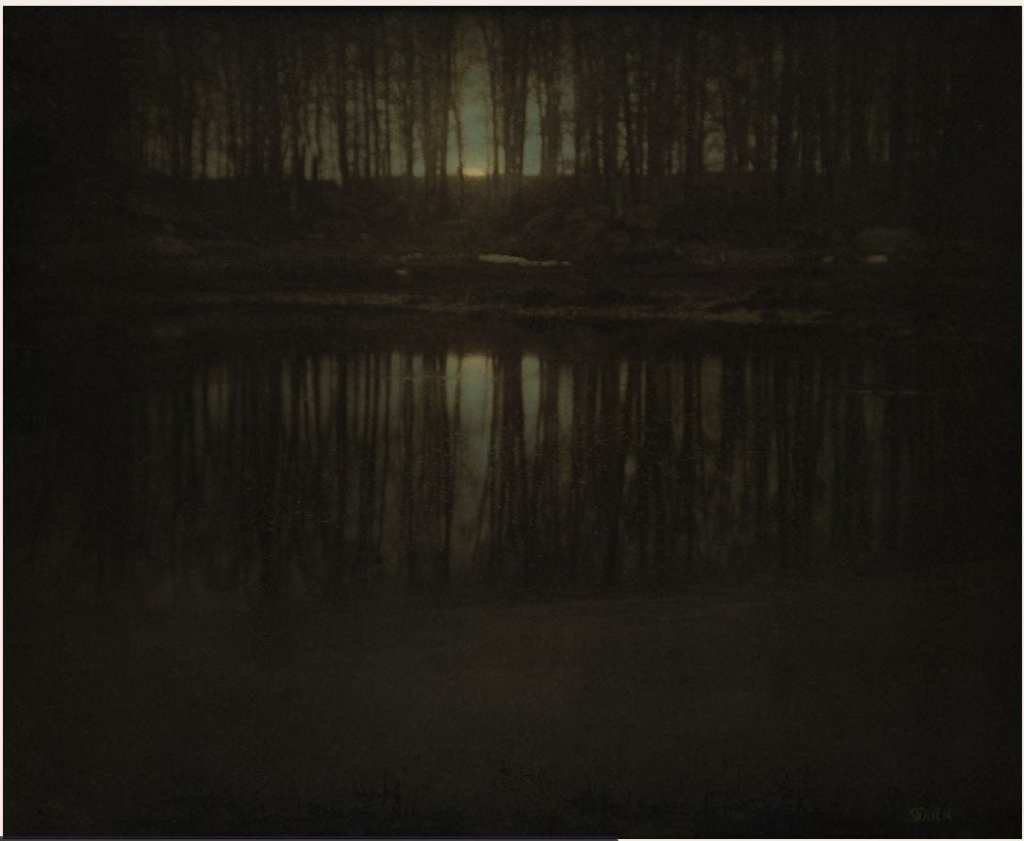
Edward Steichen (American, 1879-1973) The Pond – Moonrise
1904
Using a painstaking technique of multiple printing, Steichen achieved prints of such painterly seductiveness they have never been equaled. This view of a pond in the woods at Mamaroneck, New York is subtly coloured as Whistler’s Nocturnes, and like them, is a tone poem of twilight, in-distinction, and suggestiveness. Commenting on such pictures in 1910, Charles Caffin wrote in Camera Work: “It is in the penumbra, between the clear visibility of things and their total extinction into darkness, when the concreteness of appearances becomes merged in half-realised, half-baffled vision, that spirit seems to disengage itself from matter to envelop it with a mystery of soul-suggestion.”
The changing darkness you experience while staring at Edward Steichen’s The Pond – Moonrise is an optical illusion caused by neural adaptation in your eyes, specifically a phenomenon known as Troxler’s fading or the filling-in effect.
Because the photograph features very low contrast, deep twilight tones, and subtle gradations of dark greens and blues, your visual system struggles to maintain a fixed perception when you stare continuously at it.
Examples of Fake Digital Photographs?
The 1980s marked the birth of the digital photo manipulation era. Before Adobe Photoshop launched in 1990, publishers used massive, multi-million-dollar prepress computers like the Scitex digital system to alter photographs pixel by pixel.
The Manipulation: For its February 1982 cover story on Egypt, National Geographic needed a vertical photograph. They chose a stunning horizontal shot of the Pyramids of Giza by photographer Gordon Gahan, but it didn’t fit the layout. Using a new Scitex system, editors digitally moved the pyramids closer together so they would both fit within the vertical frame.
Ralph Lauren Blue Label jeans poster, 2009
By Ralph Lauren
While photo editing has long been standard practice in fashion, one 2009 incident broke the unspoken boundaries of acceptability. In a poster for Ralph Lauren Blue Label jeans, the fashion house so severely slimmed a photo of 23-year-old Swedish-French model Filippa Hamilton (a UK size eight) that her head ended up appearing bigger than her pelvis.
The results were ridiculed online, and Ralph Lauren was forced to apologise, saying, “We have learned that we are responsible for the poor imaging and retouching that resulted in a very distorted image of a woman’s body.”
The saga took another turn when Hamilton claimed she had been fired by Ralph Lauren for being “too fat”. On the US TV show Today,she said she had received a letter stating, “We’re terminating your services because you don’t fit into the sample clothes you need to wear.”
Hamilton said of the Photoshop debacle, “They owe American women an apology … I’m very proud of what I look like, and a role model should look healthy.”
Faked Visual Effects as “Documentary” Footage
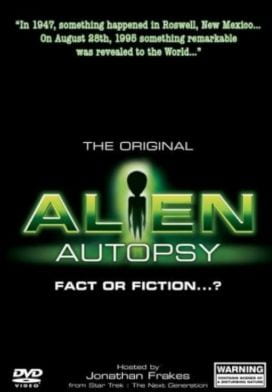
Alien Autopsy: Fact or Fiction (1995)
Overview of the Event
In August 1995, the Fox network broadcast a 17-minute, grainy black-and-white film claiming to show a top-secret government autopsy of an extraterrestrial creature recovered from the 1947 Roswell, New Mexico UFO incident. Hosted by Star Trek‘s Jonathan Frakes, the special drew 11.7 million viewers in the U.S. and was syndicated globally.
How the Hoax Was Made
Santilli initially claimed he purchased original 1947 16mm film from a retired U.S. military cameraman while searching for Elvis Presley footage in the United States. According to Santilli’s story, the original nitrate film had degraded or become unusable by the time he tried to monetize it, forcing him and his team to “recreate” or “restore” what they allegedly saw.
In reality, the footage was filmed in April 1995 inside a London flat in Camden by magician and filmmaker Spyros Melaris:
The Alien Body: Sculpted by John Humphreys (a special effects artist who worked on Doctor Who), the dummy was built over an aluminium armature and clay using latex, and stuffed with sheep brains, chicken entrails, pig eyes, and butcher off-cuts.
The Autopsy: Humphreys and others played the medical examiners, using common household scissors and medical instruments in a makeshift set.
The Look: To mask the fake props and create historical verisimilitude, the team shot on vintage black-and-white film stock and used a shaky, unfocused camera style.
Confession and Legacy
By 2006, the production team admitted the publicly broadcast footage was a staged recreation. Sculptor John Humphreys publicly confessed to building the dummy and acting in the film, and Santilli later framed the project as an “artistic restoration” rather than a malicious deception, while acknowledging substantial commercial profits from worldwide TV licenses and home video rentals
Who “Pipes” Was: The entity was revealed to be the ghost of Raymond Tunstall (or linked to a figure named Mother Seddons), a troubled man who allegedly committed suicide in the home’s under-stairs cupboard after being driven mad.
The National Séance: The core narrative conceit was that the live broadcast itself functioned as a massive, involuntary national séance. By having 11 million viewers tune in and call a supposed studio hotline, the broadcast focused the collective psychological energy of the UK, making “Pipes” stronger and allowing the entity to manifest nationwide rather than just inside the house.
Subtle Apparitions: Throughout the broadcast, “Pipes” could be spotted hidden in the background of shots—in dark corridors, behind curtains, or reflected in glass—long before the staff realized the danger.
The Climax: The investigation spirals out of control. Sarah Greene is pulled into a void under the stairs, and the live studio feed is eventually hijacked. In the chilling final moments, Michael Parkinson is revealed to be possessed by the entity, singing a nursery rhyme (“round and round the garden like a teddy bear”) just before the screen cuts abruptly to static and credits roll.
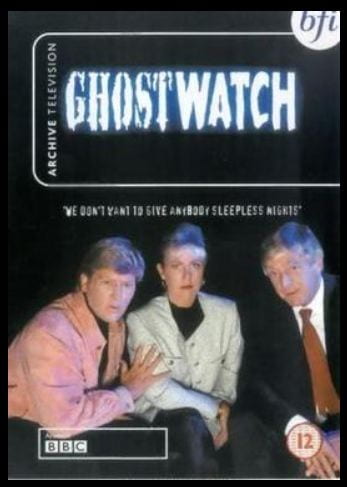
On Halloween night in 1992, the BBC broadcast a seemingly genuine, live-on-air documentary investigation of a haunted house in London.
The Hoax: Using beloved, trusted British television hosts playing themselves, Ghostwatch slowly escalated from a routine broadcast into a terrifying supernatural possession.
The Effects: The filmmakers used subtle visual cues, studio glitching effects, and blink-and-you’ll-miss-it optical overlays to hide a malevolent spirit named “Pipes” in the background shadows of the footage.
The Aftermath: The realistic presentation caused massive public panic, resulting in over 30,000 jammed phone lines and an official BBC ban on re-airing the program.
Write a definition of VFX compositing. What is it and how does it work?
Week 4:The Trend of Photorealism From Photo Fakery to Photorealism in VFX
Photorealism
Photorealism is an art technique where an artist uses photographs as visual reference to meticulously recreate a realistic image in paint or drawing. To achieve this standard in visual effects (VFX), artists must seamlessly merge computer-generated imagery (CGI) with live-action footage. The ultimate goal is to erase the boundary between the physical and the digital, ensuring the audience cannot detect the transition from reality to a digital creation.
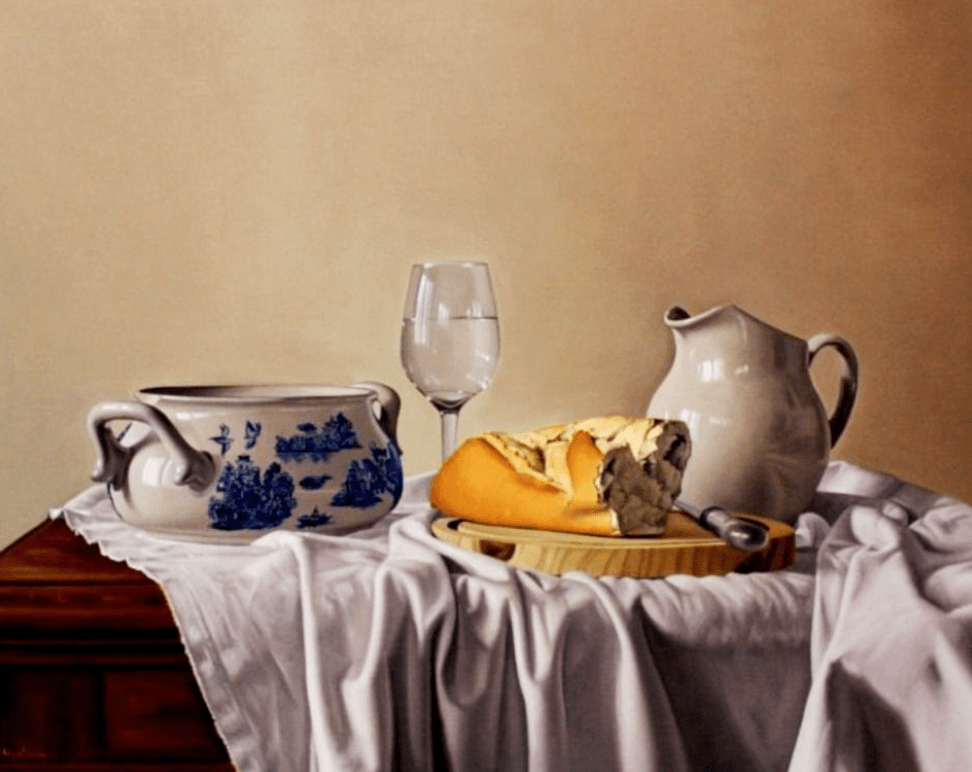
Miguel Angel Nunez – Location: Spain
This artist manifests himself in realistic and hyper-realistic still lifes. His works impress not only with the exceptional accuracy of forms and textures but also by catching the spirit and vibe of different subjects.
Most often, his “models” are food or drinks, looking at which hunger and thirst wake up. Nuñez’s work focuses on light, shadows, and textures, and his tools are mainly oil, canvas, or wood. In 1996, he took up the position of professor at the Municipal School of Visual Arts. Miguel has repeatedly participated in collective art exhibitions in Uruguay, Argentina, Chile, Paraguay, and the EU.
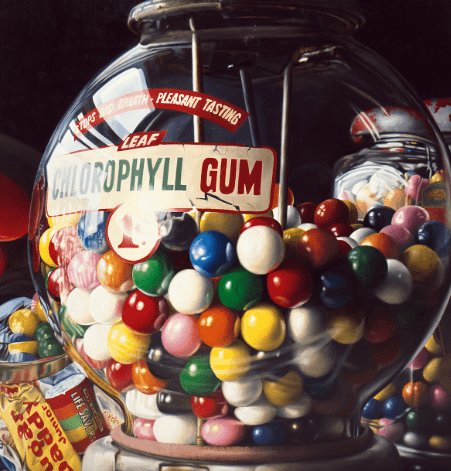
Charles Bell. Gum Ball No. 10: “Sugar Daddy”
A close-up, hyper-detailed rendering of a vintage gumball and novelty dispenser, featuring brightly colored gumballs and the classic “Sugar Daddy” caramel lollipop branding. The photorealistic Style of Bell used oil paints with meticulous precision—often translating photographic references onto canvas—to replicate tricky visual effects like refracted light, metallic reflections, and transparent glass surfaces.Like much of Bell’s 1970s gumball and 1977-onward pinball series, the piece elevates ordinary, disposable childhood treats into monumental, high-art icons, exploring how everyday mass-produced objects trigger memory and sensory perception
Stylised or Non-Photorealistic Visual Effects
Dinosaur (2000) Directed by Ralph Zondag and Eric Leighton [Film]. Burbank, CA: Walt Disney Pictures.
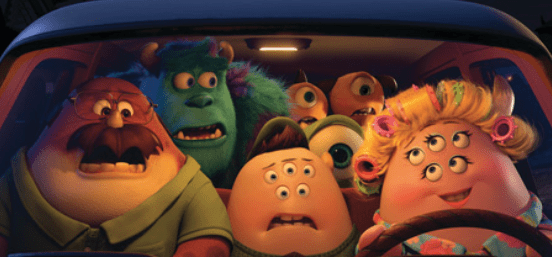
(2013) Directed by Dan Scanlon [Feature film]. Emeryville, CA: Walt Disney Pictures / Pixar Animation Studios.
Since the birth of 3D, digital artists have strived to achieve one goal. For years we tried to reach it but technology held back our dreams, hampering our attempts with slow processors, limited geometry and basic shaders. Finally, after over a decade of waiting, technology matured and we achieved the holy grail of digital art – the ability to generate the perfect digital double. Initially this wasn’t as ambitious as replacing a living actor with a virtual one, complete with flawless skin, dynamic hair and that hint of a soul behind the eyes. The dreams were more humble with us wanting something which didn’t physically exist, even if it was representing something man-made rather than organic, but when seen could fool the viewer into believing it was real, a photo even. These days, digital art is used frequently to create photorealistic images, with most results being undistinguishable from the real thing. In films, virtual actors are common place, with some now completely replacing the human in all but voice. Yet the best use of computer graphics remains those times when you don’t ever realise it’s been used. So after all that time, with all the blood, sweat and tears spilled trying to crack the photorealistic code, why should we then decide to go back and render anything in a non-photorealistic way? Just like any genre of art, 3D artists are in fact artists too. We have the same thoughts, same untameable imagination and are always experimenting with new styles and techniques to improve our work and make it more memorable.Style is the key word here. Imagine a painting by Picasso, Slavador Dali or Roy Lichtenstein. Now picture it stripped of its unique visual style and instead approached from a more realistic angle. Pop art guru Lichtenstein’s famous Whaam! would become a photo of a jet fighter shooting down another. Still an exciting image, but certainly nowhere near as unique or visually appealing. This is quite a drastic example but you get the idea. Non-photorealistic rendering, or NPR as it’s also referred to, is not just limited to painting but is in fact crucial in many other genres of art. Illustrations are a good example. The artist is free to work outside the box and live without conventional restrictions, giving characters wildly exaggerated proportions and features, all to make them more, or sometimes less, appealing. This type of art along with a bright and colourful palette is ideal in appealing to children when they are learning to read, or indeed being subconsciously taught through any other medium. If these characters were presented in a realistic way they simply wouldn’t hold a child’s attention. Comics and graphic novels are of course another area of illustration which relies entirely on the flexibility of style on each page. With the freedom of hand drawn images also comes a more engaging story line and visually stunning scenario. Both of these are either not possible, or wouldn’t be as attractive to the reader if presented in photographic form. This leads us nicely into another form of storytelling. For years Disney has charmed audiences with its animations, all rendered in their own cartoon style. Would Snow White have the same longevity if the dwarves or the evil queen had been real actors? How about trying to make an actual live fox act in Robin Hood? In these instances the style helped to tell the story, and also allowed Walt’s imagination to run wild and replace humans with animals. Again, this gave the films more charm and appeal to audiences young and old. Since then Pixar emerged and carried Disney’s torch into the 3D world but style has always been one of their key weapons. Yes, they do blur the lines occasionally, but everything always has the NPR edge to catch the eye, cause a tear to form and leave an ache in your heart. It’s not all about entertainment, of course. NPR is also widely used in many other industries. Technical renderings of a product couldn’t be possible if attempted in a realistic way. An artist can create a product, like a vacuum cleaner, and then separate the parts to be rendered for a user manual. They can even create cross sections of the appliance if needed, to help illustrate areas in more detail. This is a technique which is not possible to replicate with a photo, not without a lot more time, effort and cost. Technical manuals use NPR frequently where a photo just isn’t physically possible, or won’t aid in the explanation. Speaking from experience, when writing my own books and courses photos weren’t even considered as an approach to recreate each step. When discussing polygon limits and textures they are better represented with renderings of the actual models, which again is another form of NPR. There are more areas of life where non-photorealistic rendering is essential but I think you get the general idea. As with everything in life it comes down to personal preference but just as realistic images are needed in more simulation, or fact based areas, non-photorealism also has its place. In fact, you could argue that photorealism seems to be used more to provoke the mind, whereas non-photorealism is often aimed more towards the heart.
The Dawn of Digital Realism: How Rise of the Planet of the Apes Revolutionized Visual Effects
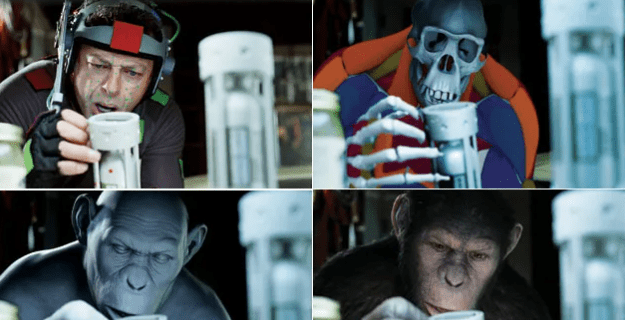
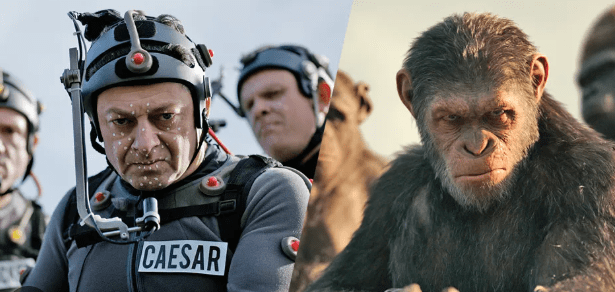
The 2011 film Rise of the Planet of the Apes represents a watershed moment in the evolution of cinematic visual effects. Developed by Wētā FX (then Weta Digital), the film achieved unprecedented photorealism by breaking free from the constraints of traditional studio sets. By pioneering outdoor performance capture and complex digital anatomy simulation, the production fundamentally altered how digital characters interact with real-world environments.
Prior to 2011, groundbreaking performance capture films like Avatar relied strictly on highly controlled, indoor “volumes”—specialized stages lined with infrared cameras. Rise of the Planet of the Apes shattered this logistical barrier by constructing the world’s largest outdoor motion capture volume directly on an open-air set of the Golden Gate Bridge. To make this transition possible, Wētā’s engineering crew developed cutting-edge daylight tracking technology. They engineered specialized infrared sensor systems and camera arrays capable of isolating performance markers and tracking actor movements flawlessly, even when subjected to shifting, bright sunlight.
Beneath the digital surface, the apes were constructed using a revolutionary “skeleton-up” anatomical approach. Animators simulated realistic muscle tissue, shifting skin, and intricate nerve bundles to mirror true biological movement. To manage the daunting task of rendering millions of individual hairs, Wētā developed a proprietary grooming tool called “BarberShop,” which allowed artists to manipulate and style individual strands of fur with unprecedented fidelity. This structural realism extended to the characters’ eyes; visual effects artists consulted medical eye doctors to accurately replicate ape blinking mechanics, micro-muscle pulls, and tear-film dynamics, successfully capturing the profound emotional depth required for the story.
At the heart of this technological triumph was Andy Serkis’s masterful portrayal of Caesar. Serkis provided a nuanced, speech-free physical foundation that served as the emotional anchor of the film. Rather than replacing his work, Wētā’s animators meticulously translated Serkis’s subtle micro-expressions and weight distribution into the digital puppet. Finally, to bring the film’s climax to scale, the VFX team utilized crowd multiplication techniques. By layering extensive motion capture libraries over a handful of core on-set performers, Wētā digitally expanded a small group of actors into a photorealistic army of 150 unique apes per shot. Through this marriage of raw acting talent and uncompromising technological innovation, Rise of the Planet of the Apes set a new gold standard for digital character creation in modern cinema.
stylised
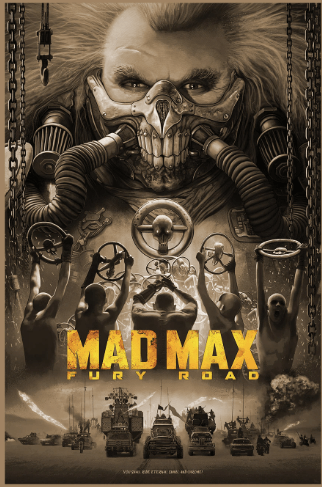
The Chromatic Chaos of the Wasteland: Aesthetic and Narrative Mastery in Mad Max: Fury Road
Cinematic dystopias have long been defined by a visual language of despair: bleached frames, desaturated grays, and the monotonous browns of a dead world. However, George Miller’s 2015 masterpiece, Mad Max: Fury Road, radically shattered these post-apocalyptic tropes by injecting a hyper-stylized, graphic-novel aesthetic into the desert wasteland. Rather than using desaturation to signal societal collapse, Miller engineered a high-octane sensory assault. The film operates on rigorous, innovative filmmaking principles that synthesize vibrant visual design, meticulous editing, and kinetic storytelling into a modern myth.
The Radiance of Ruin: Visual Style and Color Technology
The distinct identity of Fury Road relies heavily on its defiance of traditional dystopian color grading. Miller and cinematographer John Seale opted for an intensely vibrant, saturated palette dominated by scorching oranges and deep, electric blues. This high-contrast approach does not soften the brutality of the wasteland; instead, it heightens the environmental hostility, making the desert heat feel visceral and oppressive.
To maintain this stylized clarity throughout the film’s shifting timelines, the production team bypassed traditional filtration in favor of a specialized day-for-night grading process. Night sequences were deliberately shot overexposed during the brilliant desert day. In post-production, these frames were digitally graded down to a nighttime spectrum, preserving deep shadow details and a surreal luminosity that standard night shooting could never achieve. This hyper-clarity is further concentrated at the micro-level through rotoscoped eyeballs. Editors individually isolated, sharpened, and brightened the actors’ eyes in post-production. This subtle, uncanny glint ensures that the human element remains a piercing focal point, drawing the audience’s gaze even amidst chaotic action and dim lighting.
[Traditional Dystopia] ───► Bleached Grays / Desaturated Browns / Low Contrast
[Mad Max: Fury Road]  ───► Scorching Oranges / Deep Electric Blues / High Contrast
Kinetic Geometry: Composition and Editing
The breathless pacing of Fury Road is a triumph of technical editing, made coherent through the strict application of center-frame composition. By placing the primary action or focal point dead center in almost every shot, Miller utilizes an “eye-trace” technique. This structural discipline ensures that as the film cuts rapidly between chaotic vehicular explosions and hand-to-hand combat, the viewer’s eyes do not have to hunt across the screen. The brain processes the sequential images instantly, maximizing the impact of the action without causing visual fatigue.
This seamless visual flow stems from the film’s unique inception: it was not written as a traditional script, but rather conceived as a graphic novel storyboard. Comic book artist Brendan McCarthy helped draft over 3,500 hand-drawn frames before filming began. Consequently, the finished movie functions as a living, breathing flipbook. Operating with the rhythmic momentum of a high-octane silent film, the editing relies on pure composition and movement to dictate the narrative cadence.
Anthropological Action: Storytelling Through Design
At the core of Fury Road is a absolute commitment to the rule of “show, don’t tell.” With fewer than 2,000 words of dialogue in its entire runtime, the film discards expository monologues. Instead, complex world-building, theological cult structures, and shifting social hierarchies are revealed entirely through costume design, weapon modifications, and environmental cues. The history of the world is etched directly into the objects and skin of the people who inhabit it.
Creates an immersive, surreal, and unforgettable dreamscape.
Physical Grit
150+ functional vehicles, live stunts in the Namibian desert
Grounds the hyper-stylized world in terrifying, tangible stakes.
This interplay between the surreal and the tangible is anchored by the extensive use of practical effects and live stunts. The production built and destroyed over 150 real, functional vehicles in the Namibian desert. Because the crashes, explosions, and physics are real, the film possesses a gritty weight that CGI cannot replicate, balancing the heightened comic-book grading with genuine physical danger.
Finally, this design-driven world is populated by characters who function as mythic archetypes rather than purely psychological portraits. Max is the mute, wandering cowboy or Ronin samurai; Immortan Joe is the grotesque, decaying tyrant king; and Furiosa is the fierce, reluctant savior. By stripping away contemporary neuroses and leaning into these timeless, elemental archetypes, Miller elevates a simple two-hour car chase into a universal fable about survival, redemption, and human resilience. Through its revolutionary marriage of comic-book stylization and raw physical stunt work, Mad Max: Fury Road stands as a definitive proof that action cinema can be a profound medium for high art.
Week 5 Digital indexicality
Digital indexicality – the capture of movement for computer animation. This week, we will examine where, how, and in what ways indexicality can be found in the digital, specifically through the capture of movement. Visual effects are sometimes seen as the art of artifice, yet they contain indexical references. CGI characters as 3D models are purely iconic; they have no connection to real actors or people, yet does the technology of motion capture feed the digital character with indexical movement?
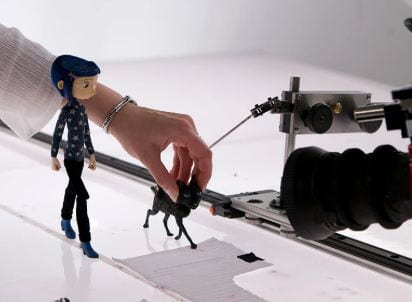
The Hand-Crafted Code: Digital Indexicality and Hybridity in Coraline
The advent of digital cinema provoked a profound existential crisis within film theory. For decades, classical theorists grounded the ontological integrity of the cinematic medium in indexicality the idea that a filmic image is a direct, physical trace of reality, structurally bound to its source like a footprint in the sand or light chemically burned onto celluloid. When computer-generated imagery (CGI) began replacing live-action photography, scholars lamented the “death of cinema,” arguing that a medium built on mathematical code lacked an authentic connection to the physical world. However, Henry Selick’s 2009 stop-motion feature, Coraline, subverts this neat binary by demonstrating a high degree of digital indexicality, creating a hybrid space where physical craftsmanship and digital capture exist in a recursive loop.
Unlike purely virtual animations where characters exist only as code, Coraline was shot frame-by-frame using high-resolution Nikon D700 digital SLR cameras. When the camera shutters clicked on the sets of LAIKA Studios, the digital sensors recorded actual, physical light bouncing off real fabric, painted resin, miniature furniture, and silicone puppets. The depth variations, dust particles, and subtle textures of human touch were permanently encoded into pixels. The resulting digital files serve as an authentic indexical record of a concrete physical space that truly existed in front of the lens. Rather than breaking away from reality, the digital camera functions as an archivist of the physical world, proving that data can carry the weight of material presence.
[Physical Reality] ──(Light Bouncing)──> [Digital SLR Sensor] ──> [Indexical Digital Data (Pixels)]
The true technological breakthrough of Coraline lies in its revolutionary use of 3D printing (Rapid Prototyping) for character facial expressions. Animators modeled thousands of facial movements digitally in a computer environment. These expressions were then printed via a 3D printer into tangible, physical resin components that were manually placed onto the puppets frame-by-frame. This methodology creates a complex, cyclical indexical loop:
In this structure, the computer is not merely a post-production tool; it is an active participant in creating physical reality. The final digital image on screen is an indexical trace of an object that was born out of digital code, rendered into three-dimensional matter, and re-translated back into code by a digital camera sensor.
This ontological evolution directly addresses the primary debates of digital media theory. In The Language of New Media, theorist Lev Manovich claimed that the digital turn transformed cinema into a subgenre of painting—an art form driven by graphics and hand-modification rather than a recording of reality. Conversely, film historian Tom Gunning argued that moving from analog film strips to digital files does not destroy indexicality, because a digital photograph is still generated through an initial physical event—light hitting a sensor.
Theoretical Framework
View on Digital Indexicality
Application to Coraline
Lev Manovich
Cinema becomes a subgenre of painting; digital manipulation replaces pure recording.
Applies to Coraline‘s background compositing, CGI environmental extensions, and digital seam-erasure.
Tom Gunning
Indexicality survives via the initial physical event captured by the digital sensor.
Applies directly to the core puppet movements and real lighting conditions recorded by the Nikon cameras.
Coraline stands as a bridge between Manovich and Gunning. The film confirms Gunning’s view because its central moving figures are anchored in physical, photographic reality. Yet, it simultaneously validates Manovich’s perspective by utilizing digital compositing to erase puppet facial seams and expand environments.
Finally, this technological hybridity is intentionally leveraged to trigger the uncanny valley effect. Purely digital CGI characters often look smooth and weightless, sliding out of the uncanny valley through abstraction. Stop-motion puppets, however, possess tangible mass and authentic gravity. Because they are indexical records of physical items, our eyes instinctively register them as real, material objects, yet their mechanical movements defy natural biology. This creates a state of psychological dissonance: the digital camera verifies that the puppet physically exists, while the frame-by-frame animation proves that it is completely artificial. The digital indexicality of the medium directly mirrors the narrative trap of the Other World—a space that looks beautifully hand-crafted and welcoming on the surface, but is driven by a calculated, synthetic engine underneath.
Ultimately, Coraline demonstrates that the transition from analog film to digital data does not spell the death of the index. By running digital designs through 3D printers and capturing them on digital SLR cameras, the film invents a new vocabulary of digital indexicality, proving that cinema can remain deeply tethered to reality even when it is constructed from code.
What fosters effective teamwork? It’s not just about grouping individuals together and hoping for the best. It’s about cultivating an environment where trust, open communication, mutual respect, and a shared vision converge.
In an ever-shifting business landscape, adaptability isn’t just a trait—it’s a competitive advantage. Companies that embrace change, learn from challenges, and pivot when necessary are the ones that not only survive but also thrive in uncertain environments.